From £625
Fuseboard changes across Dorset
A fuseboard, consumer unit and fusebox are three names for the same thing: the grey or cream box the whole property hangs off. When an EICR comes back unsatisfactory, the board is often where the answer lives.
The bundle: new consumer unit with surge protection + EICR, £675 flat
If the board is being replaced anyway, have the whole installation tested in the same visit. You get the new consumer unit with surge protection, every circuit tested and labelled, and the full EICR certificate - one flat £675, nothing added on the day.
That certificate matters: it proves the whole installation, not just the new board, and for a rented property it restarts the five year clock.
Why an EICR keeps pointing at the board
Testing works outward from the consumer unit, so it is the first thing we open and the thing we spend longest with. An older board can produce several codes on its own, before we have tested a single socket.
Common ones: no RCD protection on circuits that need it, a wooden or cast iron enclosure that would not contain a fire, rewireable fuses that can be repaired with the wrong sort of wire, no labelling so nobody knows what turns off what, and connections that have loosened with years of heating and cooling.
Change the board and a cluster of codes clears at once. That is why the two jobs come as a pair so often, and why it makes sense for one person to do both.
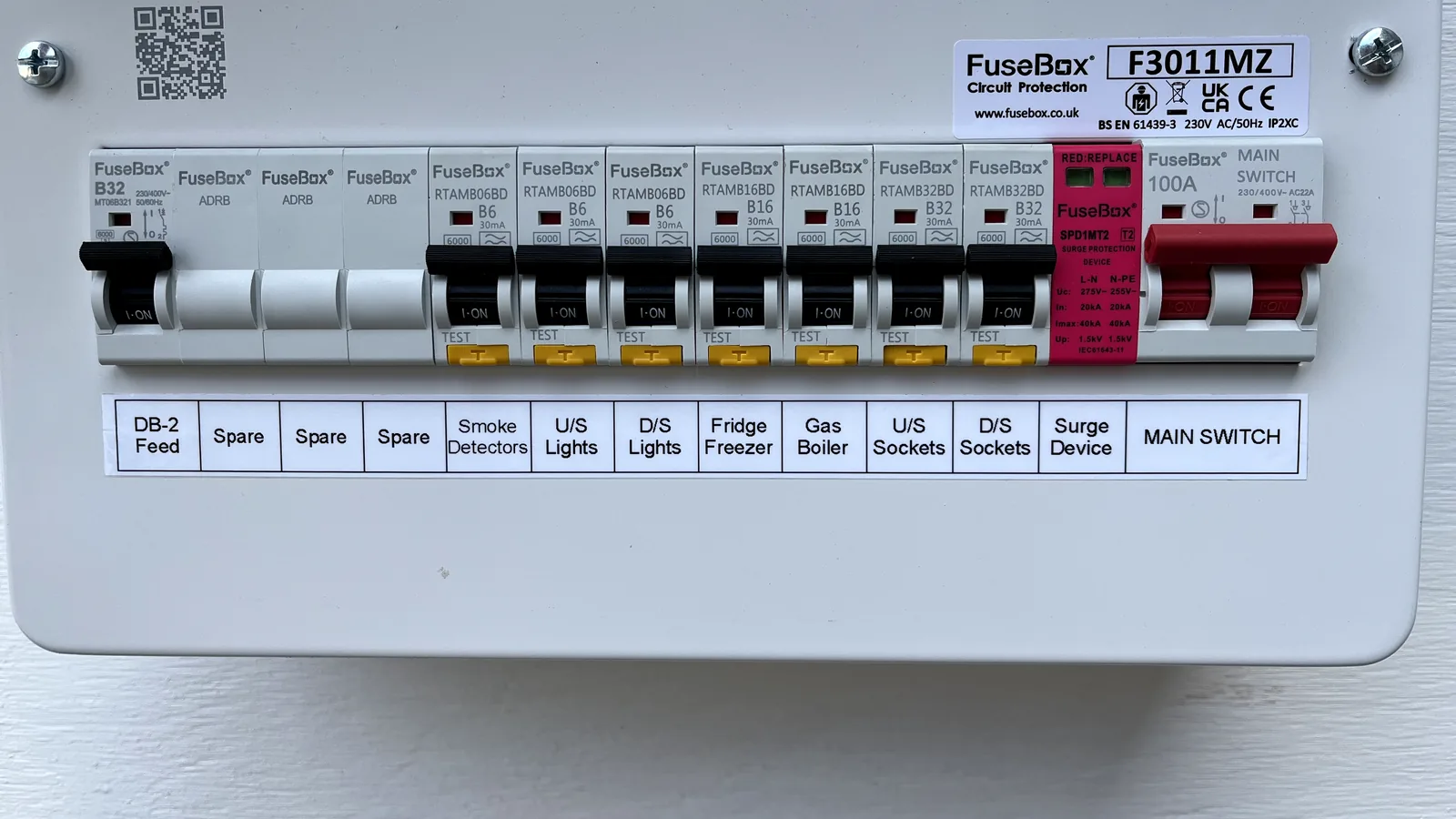
What a modern board adds
Four practical differences, in plain terms.
RCD protection
An RCD watches the electricity going out and coming back. If some of it goes missing, which is what happens when it finds a person or a wet wall instead of the return wire, it cuts the supply. A 30 milliamp RCD has to break the circuit within four hundredths of a second at the current that matters, and a healthy one does it faster than that.
An ordinary fuse or breaker will not. The leak through a person is far too small to blow it, so on a circuit with no RCD there is nothing that switches the power off at all. That is the real difference, and it is why the report codes a missing RCD rather than mentioning it in passing.
Circuits kept apart
On many boards we replace, one fault takes half the house out. Give every circuit its own trip and a fault only switches off the circuit it happened on. A failed kettle takes the kitchen sockets out and leaves the lights on. A wet outside light takes out the outside light and leaves the indoor sockets running.
Whether two particular appliances stay separate depends on which circuits they are wired to, not on the board. If keeping something like a freezer on its own matters to you, say so and we will tell you what the wiring actually allows before you decide.
An enclosure that contains a fault
Older boards were built with wooden backs or plastic that will burn. Current boards are made to hold a fire in rather than let it out into the hallway, which matters most in a flat or a shared house.
Labelling that means something
Every way marked with what it feeds. Handy for you, and genuinely useful for a tenant who needs to reset something on a Sunday night without ringing anyone.
Signs the board is due
- Fuse wire. Little ceramic or bakelite carriers you pull out and rewire by hand.
- A wooden back board or a cast iron case, common in the older stock around Weymouth, Dorchester and the Bridport terraces.
- No test button anywhere on it. No test button usually means no RCD.
- Nothing labelled, or labels in biro from two owners ago.
- Additions bolted on the side for a shower, an extension or a garden office, each with its own little box.
- An unsatisfactory EICR with several codes that all trace back to the same enclosure.
What happens on the day
The supply goes off for the working part of the day, so we agree that with the tenant or with you beforehand. The old board comes out, the new one goes on, every circuit is reconnected, tested and labelled, and the property goes back on with everything checked.
You get a certificate for the work when it is done. If we changed the board because of an EICR, we tell you which codes it clears and update the report so your file reads correctly.
Board first, or report first?
Report first, nearly always. An EICR tells us what the wiring behind the board is actually like. Fitting a new board onto tired wiring can turn up faults that were being masked, and it is better to know that before you spend rather than after.
Prices
Fuseboard change from £625. EICR from £160. What moves the figure is the number of circuits, the state of the tails and earthing, and how much space there is to work in. The final quote is confirmed in writing before any work starts.
Want the board looked at?
Tell us what is on the wall now and where the property is. Anywhere in Dorset, from Shaftesbury down to Swanage.